
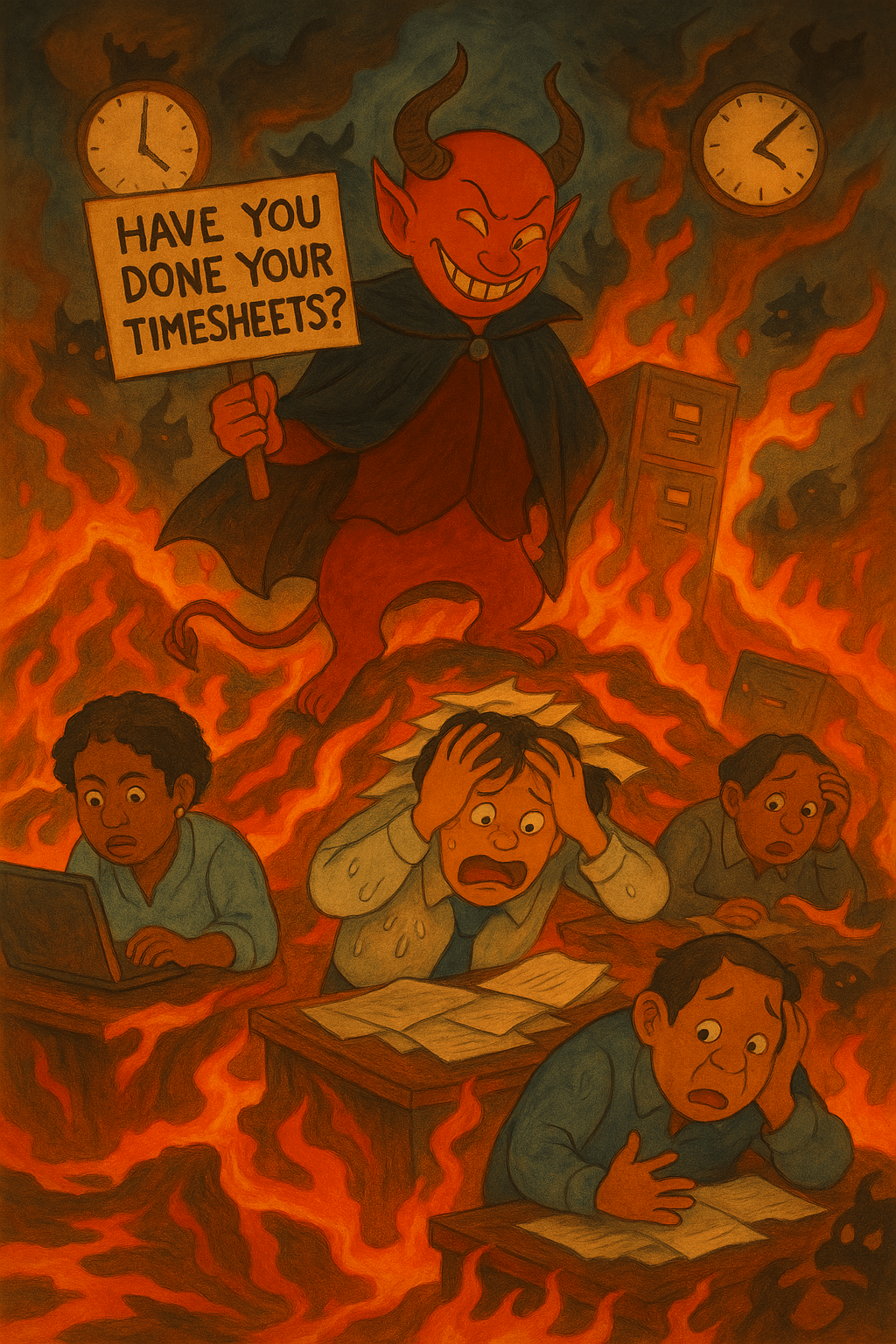
Let’s talk timesheets.
Some people – perfectly innocently – see timesheets as a cornerstone of MER (Monitoring, Evaluation, & Reporting).
For me, however, the mere mention of the word conjures an absurd, soul-crushing caricature of corporate life.
For me, timesheets quintessentially symbolise the infantilisation of the workforce, and the concurrent shift from trust-based environments to hyper-surveillance panopticons. I think it’s fair to say they’re one of the root causes of the mental health crisis sweeping through the knowledge economy today.
Hourly billing, and time-based (as opposed to outcomes- or deliverables-based) remuneration, is an egregiously misanthropic paradigm. Timesheets are the fine line between meaningful, productive employment and modern-day wage slavery.
But the true cost of timesheets is far more insidious. They subconsciously programme the mind of the knowledge worker to become a box-checker; silently eating away at innovation, initiative, and spontaneity.
Whether consciously or not, timesheets end up programming us to optimise for clocked hours, not impact. To do the bare minimum that fills the time, rather than our best work.
I get that to many business leaders timesheets are a necessary evil, and not something they relish imposing on subordinates, but surely in 2025 there must be a better way?
Did I mention that I don’t like timesheets? 😉
The above is intended as banter, not thought leadership. (Probably.)
 Mike Whyle - Writer & Creative