
Electric Dreams: Using AI to Imagine Drug Using Spaces
– Published on TALKING DRUGS – November 16, 2022
AI-assisted art has been taking the world by storm, providing a new world-building method that leverages the width of the internet’s resources to construct and imagine new realities.
TalkingDrugs teamed up with Mike Whyle, a South African artist with experience in cannabis cultivation, to employ AI art to tackle the question of what drug consumption rooms could look like in a (hopefully) not too distant future.
While legal consumption rooms currently exist through a medical framework, emphasising safety and public health over “recreational” enriching experiences, we decided to go beyond these current limitations and imagine an ideal drug using space, as utopian as that may feel right now.
While the offered images may not be realistic now, they’re an exploration of what could possibly be real, focused on guiding principles of love and respect for nature and a holistic view of a healthy life.
AI-assisted digital art is still in its infancy, but I have no doubt that its impacts will be immense and far-reaching. Today we run python codes – the building blocks of the metaverse – to construct dream machines. Tomorrow we’ll be able to inhabit them.
As an early adopter of this tech, I’d previously only really used it for flights of fancy, escapism – a form of digital hallucination, reliably releasing dopamine into the brain, especially when finding aesthetic images. As such I was hugely excited to test its potential for a real-world project.
The brief – to have text-to-image AI envisage what legal and socially accepted drug consumption spaces could look like – soon proved to be a vibrant wellspring of intersectional ideas to imagine spaces where adults are allowed full sovereignty over their bodies and minds, as well as the future we want to create.
The French and English coffeehouses analogy – melting pots of spaces where ideas were shared freely, alternative narratives entertained, and substances shared – is one example shared spaces in which the use of certain substances is socially sanctioned. The safe spaces in South and Middle America where sacred shamanic plant medicines like ayahuasca are ceremoniously consumed as a form of soul therapy, is another.
Here in South Africa there is a (largely undocumented) subculture of psychedelic drug use sessions among friends as a way to connect with nature, validate each other, or just take breaks from normal life. In this context, a lot of discussions centre around emotional “space keeping”, as well as physical facilitation of a meaningful shared journey. These sessions served as a personal point of departure to explore this project.
This got us thinking about not only how the spaces would look, but how they could look considering the associated contextual (historical, environmental, technological etc.) changes that would need to happen to facilitate the existence of socially accepted, legal consumption spaces that have positive rather than negative connotations around drug use.
I soon realized that health and wellness – both inner and outer – would be integral aspects. I imagined spaces ensconced within nature – not displacing it. Therapeutic, not medicalised, but with access to emergency services if ever needed. Spaces where you could go to “zone out” for a while. Spaces of quietude and contemplation, as well as friendship and revelry, revitalizing and reinvigorating you so that you return to “normal life” with a renewed resilience. The healing powers of nature itself are a key piece of this puzzle, and a reason that such religious ceremonies largely take place outdoors, in nature.
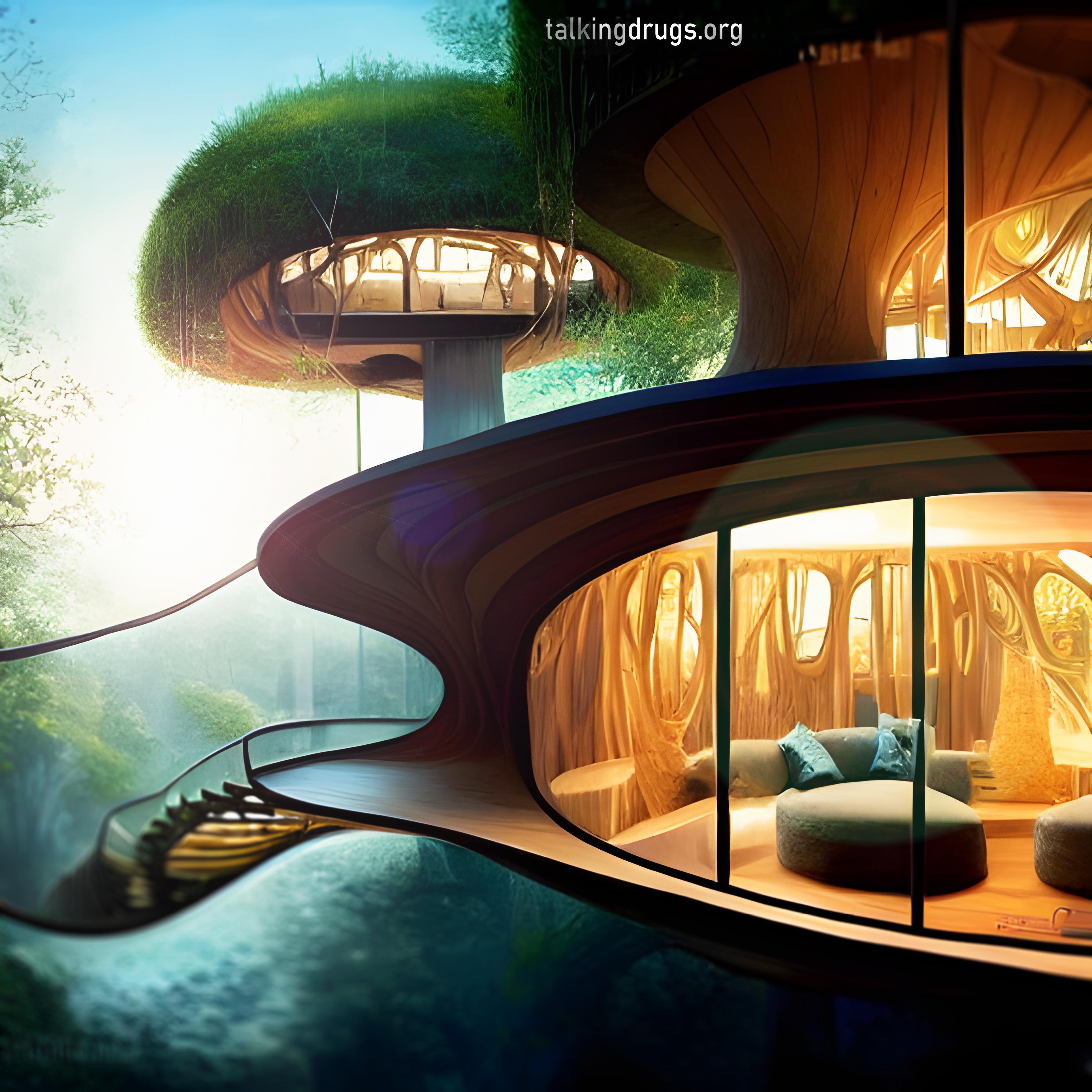
The overarching concept of the treehouses, inspired on a natural setting for drug use. Both within water, suspended mid-air and above the canopy, each space allows for social seclusion as well as contact with our surrounding environment.
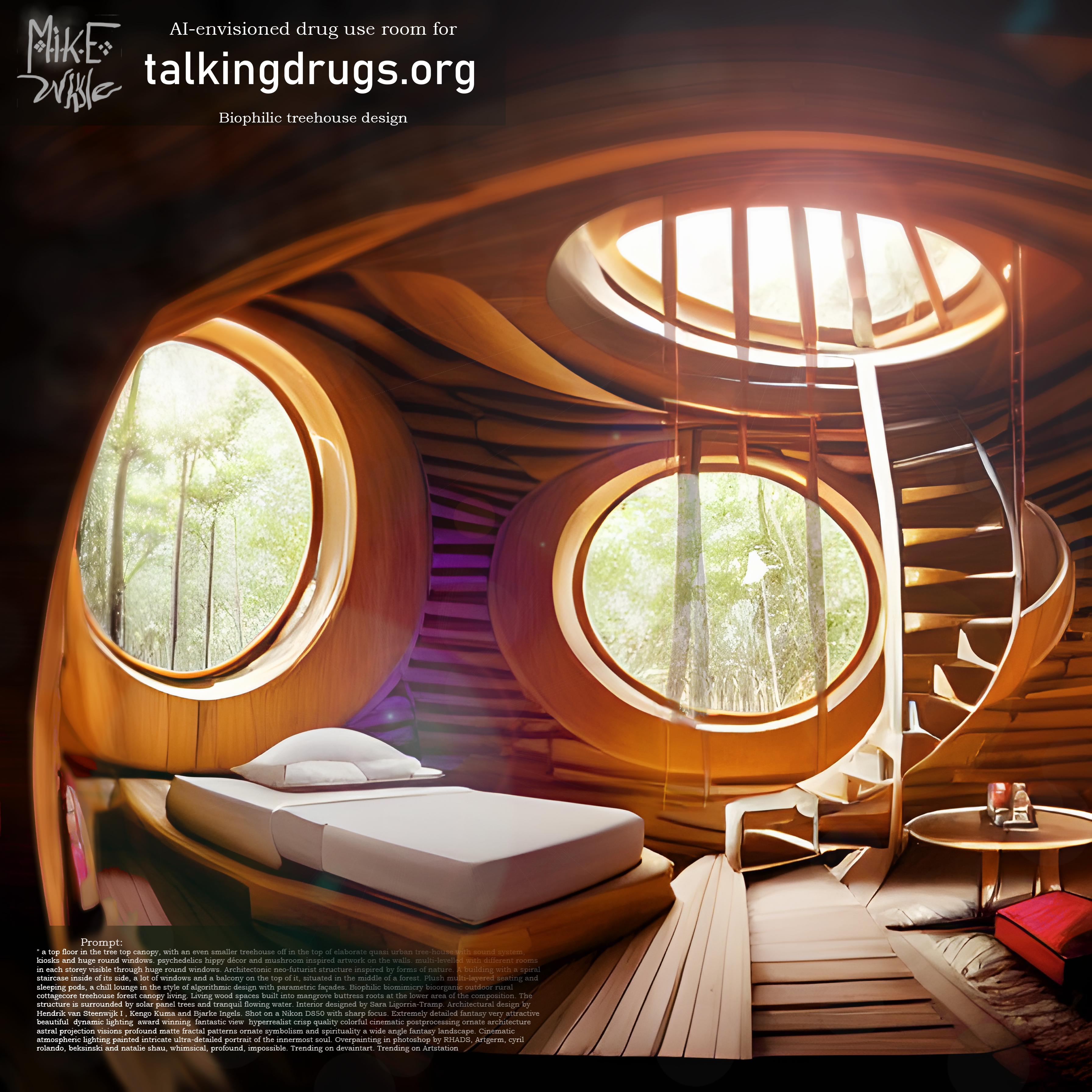
Further details of the interior of these spaces, designed for comfort, natural materials, open views into the surrounding environment, and levels to explore the mushroom-like treehouses.
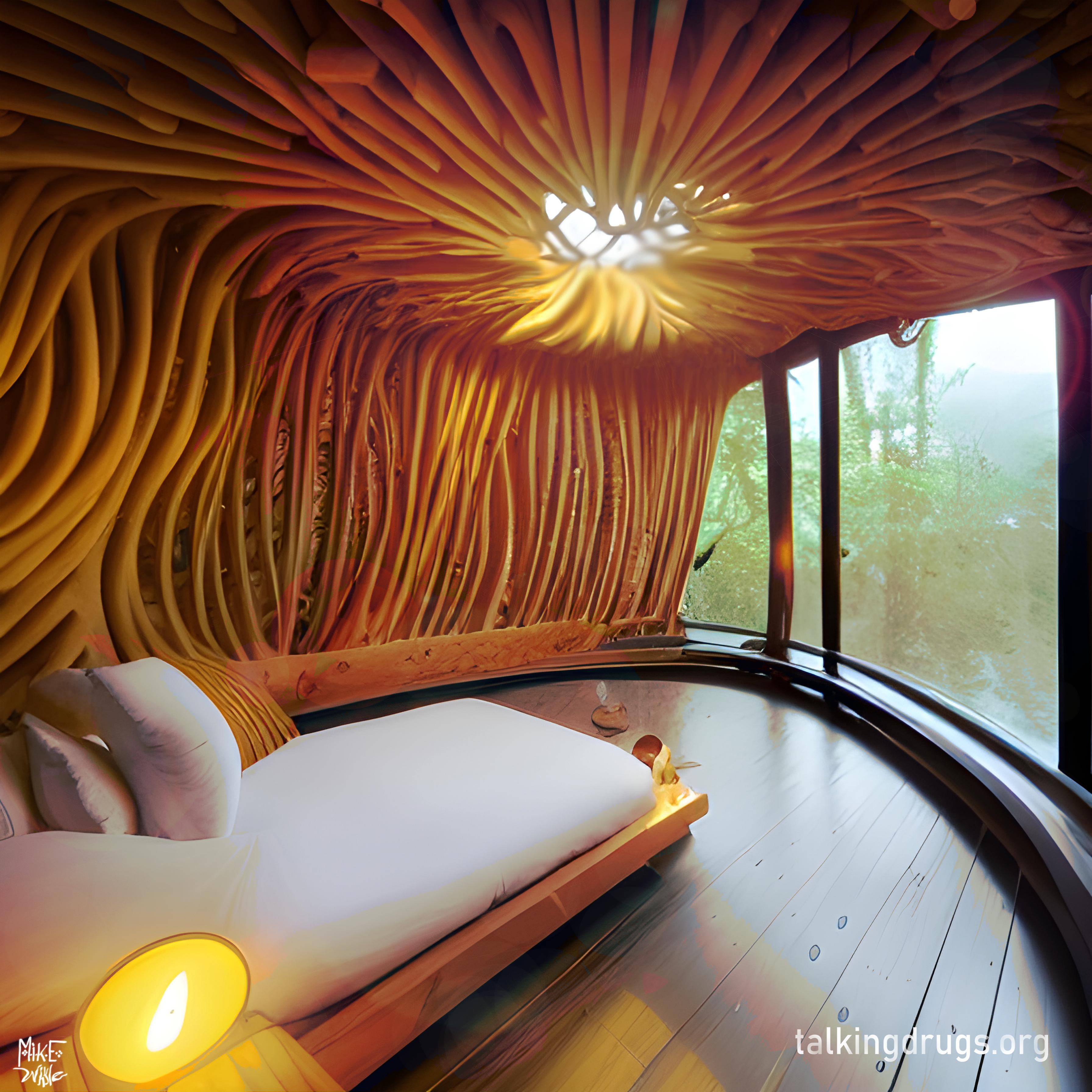
Details of other rooms, with the walls an ceiling mimicking the lamellae (gills) of mushrooms. Soft lighting with expansive views in these more private rooms allow for individuals or small groups to enioy their mental and surrounding landscapes.
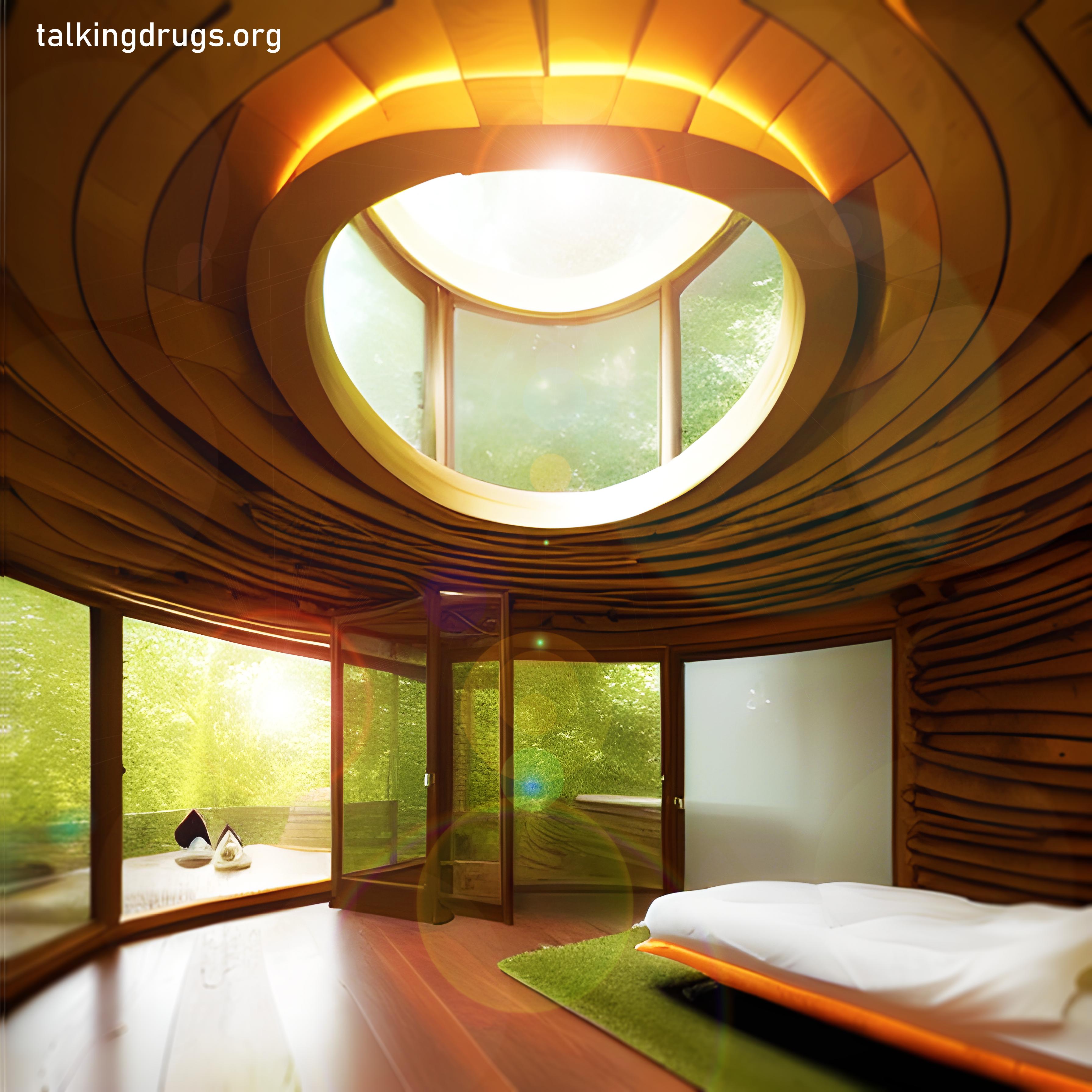
Ribbed textures of roots on the wall, with natural light spilling in from all directions. Closely located yet protected from nature means such spaces could be enjoyed at any time of the day or in any weather.
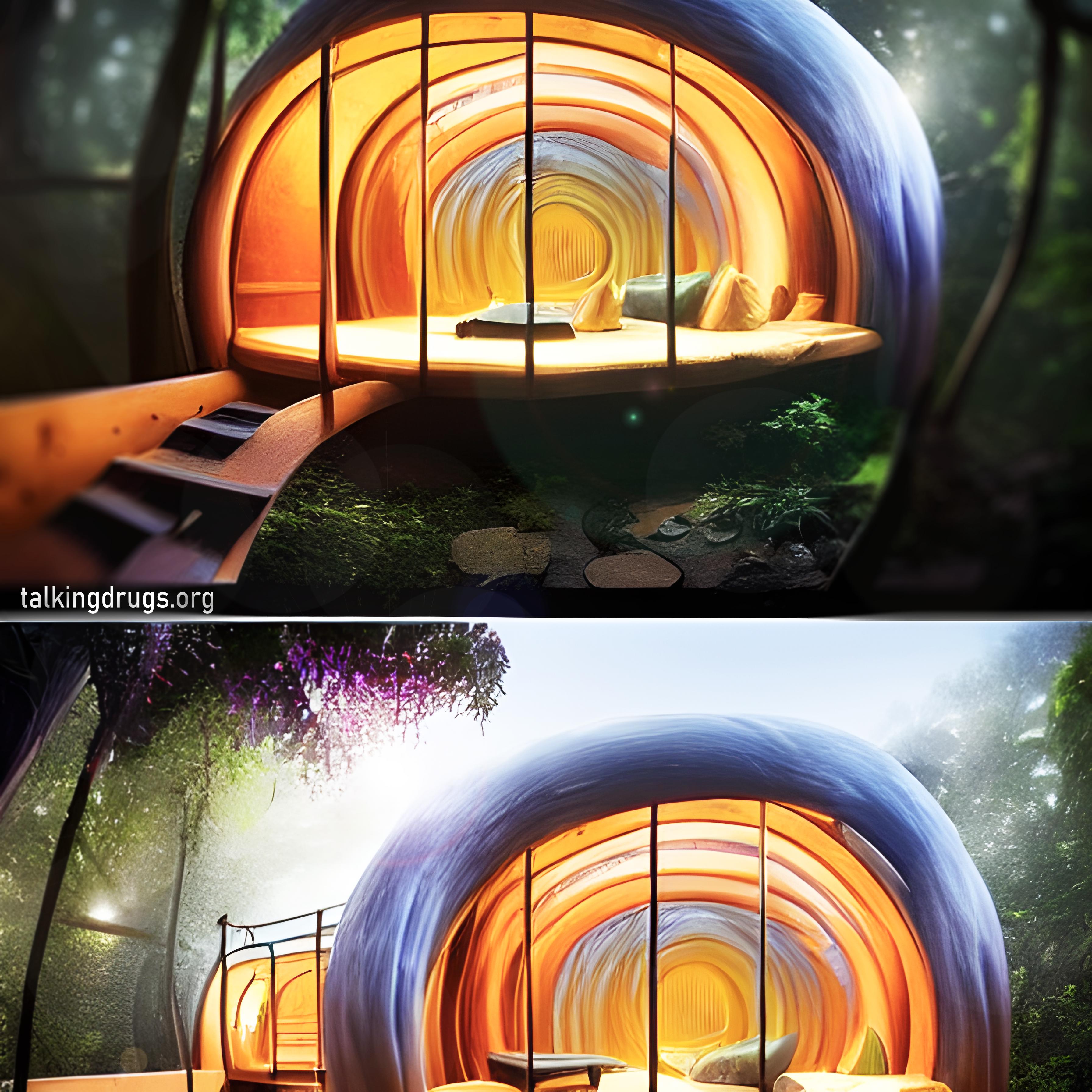
These indoor-outdoor buildings are an architectural metaphor for the connection between ourselves and our ecosystem, our mind and our surrounding universe. The warm lights could be a guiding beacon, particularly when exploring greenery at sunset.
Exploring greenhouses
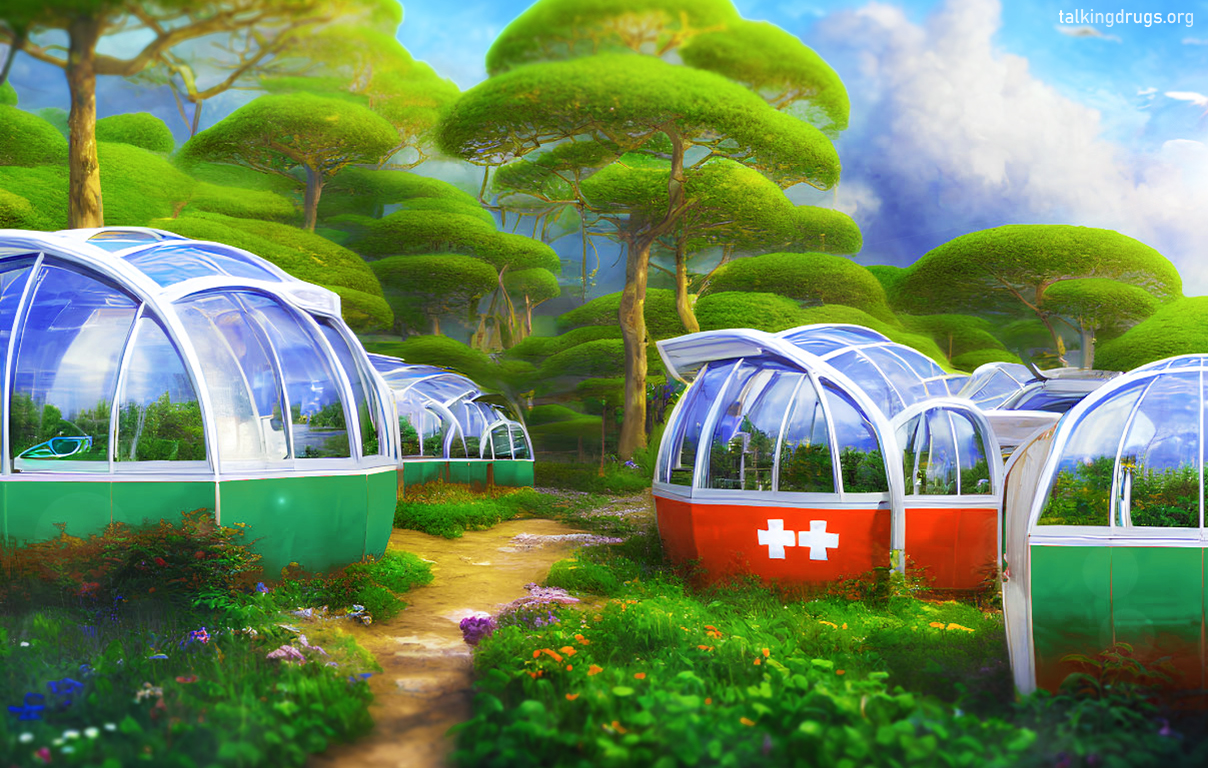
An exploration on how individualised domes could exist, embedded within greener spaces for exploration. These domes could also be used to grow crops to improve the sustainability of spaces. Well demarcated spaces for recovery and medical attention are useful signage for health-related services.
Biomimicry, biophilic design that non-invasively integrates into nature, suggests that humans are situated within nature: a part of it, not above it. In the future, it may even be possible to grow living treehouses for eco-friendly accommodation, while other species of plants are engineered for the purposes of wall-paper, biodegradable packaging, and bioluminescent lighting!
Exploring these yet-unseen spaces soon revealed beautiful places with land art, flowing water, and aquaponic-like greenhouses, where the constant sound of flowing water adds a sort of natural white noise ASMR background noise. It would also serve to sonically insulate the space from nearby noisy urban zones.
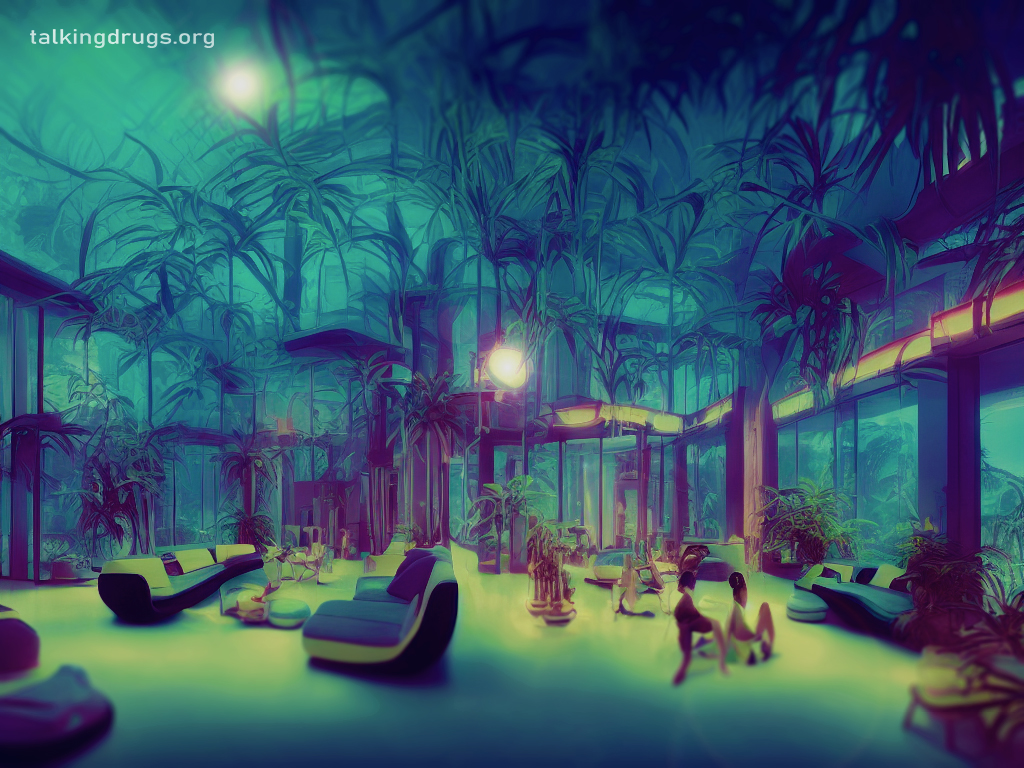
A human greenhouse: comfortable seating across a wide hall, surrounded with flora that can create private alcoves for groups of psychoactive travellers. The blue and green tones could be replicated with lighting, providing an aquarium-like environment for people to enjoy their experiences.
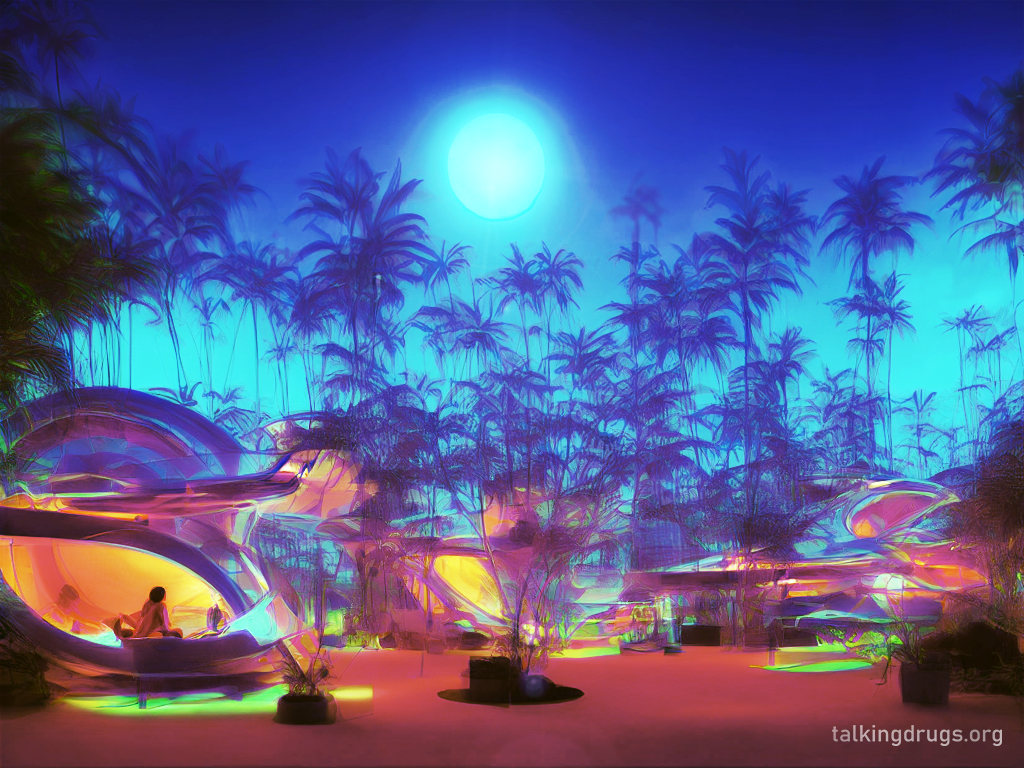
A more greenhouse-inspired drug using place, this time demonstrating several smaller pods connected within a larger space. This allows for intimate experiences while still protected in immersive greenery. These design elements take on a more futuristic look, yet with no hard lines or angles as they aren’t found in nature.
The concept of internal/external health and wellness are also crucial for exploring any different modes of conscious thought. Imagine if food and beverage were produced sustainably on site at these spaces to optimise wellness. Food kiosks with food, snacks and beverages that are locally and sustainably produced on site at these spaces could augment the psychedelic and therapeutic drug offerings, in a symbiosis geared towards optimum human wellness.
This in stark contrast to dystopian late-stage capitalism futurist scenarios where technofascism has almost annihilated nature, and populations of impoverished masses are subdued and coerced with mass-produced drugs that keep the masses hooked.
Some researchers have suggested that it is largely the conditions we live in under late-stage capitalism that trigger addictive behaviours. It’s worth asking ourselves: if we solve societal problems like scarcity and inequality – entirely feasible with current technology – would people still engage in addictive drug behaviours in these spaces? Or, with many triggers erased, would we naturally trend towards a moderate and balanced holistic drug use? I would venture that these spaces, much like the Amsterdam coffee shops by the canals, and vineyards with on-site tasting, would amplify, rather than subtract from, our experiences of life.
 Mike Whyle - Writer & Creative